Supermarket Bakery Equipment: Capacity, Consistency and Waste-Control Guide
Updated: Aug 30
Supermarket bakery equipment should be sized around service windows, SKU mix, labor and shrink—not catalog capacity. A reliable plan starts with the operating model, converts demand into peak-hour trays, standardizes product controls, and then matches equipment bundles to each store archetype.
Choose scratch, bake-off or hybrid production before choosing machines.
Size the bottleneck from the busiest replenishment window, not only daily volume.
Standardize piece weight, proofing, baking and pack rules before adding SKUs.
Treat waste as lost production capacity and measure it by reason.
Use one RFQ basis across stores so suppliers quote the same production problem.
Start Supermarket Bakery Equipment Planning with the Operating Model

The operating model determines where skill, cold storage and production risk sit. Buying a mixer, proofer or oven first and deciding the model later usually creates unused capacity on one station and queues on another.
Operating model | Best fit | Main constraint | Typical equipment emphasis |
|---|---|---|---|
Scratch in-store | Flagship or differentiation-led stores | Labor skill and process control | Mixer, divider/rounder, proofer, deck or convection oven |
Bake-off | Labor-tight stores and rapid rollout | Cold chain and replenishment rhythm | Freezer/chiller, proofer, convection oven |
Hybrid | Most multi-store networks | Keeping scratch and bake-off paths from competing | Core scratch equipment plus simple bake-off capacity |
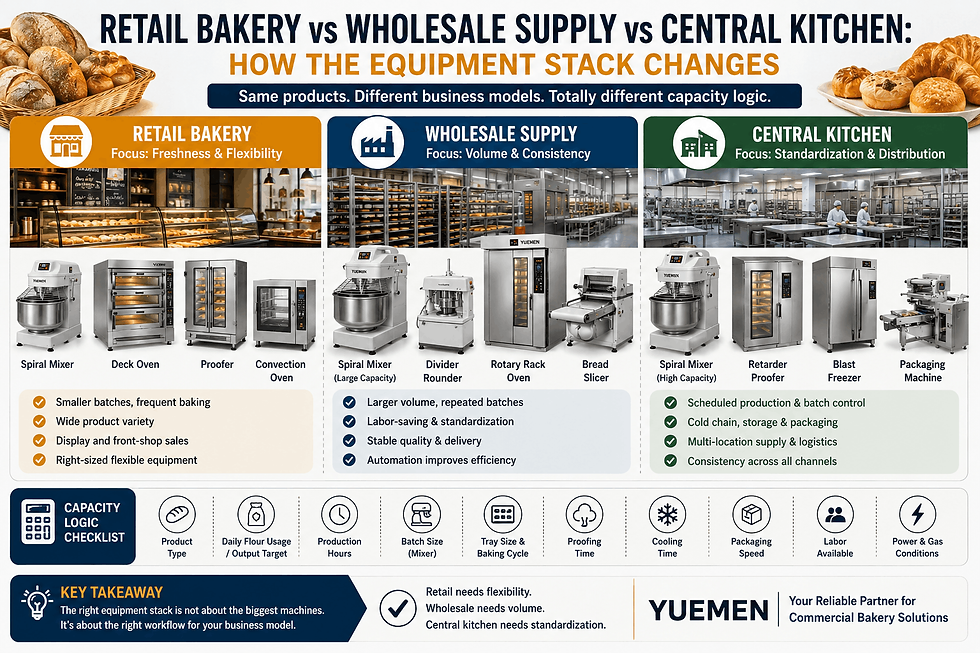
If several outlets are supplied from one production site, move the upstream capacity problem into a central kitchen bakery equipment plan and keep the store equipment focused on finishing, replenishment and presentation.
Size Supermarket Bakery Equipment Around Peak Demand

Daily volume hides the real bottleneck. A store can have enough nominal oven capacity for the day and still miss the breakfast, lunch or evening replenishment window. Capacity planning should therefore start with the share of demand that must be produced inside the busiest window.
Use trays per hour as the common capacity language
Translate saleable pieces into trays per hour before comparing ovens, proofers and labor. Then add a practical operating buffer for loading, cleaning, small stops, product changes and growth. A line that needs 95% of catalog capacity to survive a normal peak is already undersized.
Stage | Capacity basis | What to verify |
|---|---|---|
Mixing | kg/batch and batches/hour | Real dough temperature, batch cycle and changeover |
Dividing / forming | pieces/hour | Piece-weight accuracy at target dough condition |
Proofing | trays or racks in dwell time | Occupancy at peak and recovery after door openings |
Baking | trays/hour | Load pattern, bake cycle and recovery between batches |
Cooling / packing | trays or packs/hour | Space, cooling time and peak labor requirement |
Control Consistency Before Adding More SKUs
A supermarket bakery becomes difficult to scale when every SKU carries a different tray, proofing program, bake profile and handling rule. The first control point is not the number of products; it is the number of production paths staff must execute correctly during a peak.
Piece weight and tolerance: protects yield, bake time and pack consistency.
Proof target: time, temperature, humidity and acceptable height range.
Bake target: time, temperature, steam or airflow setting and color standard.
Cooling and holding: minimum cooling time, display life and markdown cutoff.
Pack format: pieces per pack, final dimensions and label-ready presentation.
Private-label products need even tighter acceptance limits because the retailer owns the customer promise. For buns and rolls, use the private label buns and rolls scale-up playbook to define piece-weight, proofing, baking and packaging controls before equipment sign-off.
Use Supermarket Bakery Equipment to Reduce Waste, Not Hide It
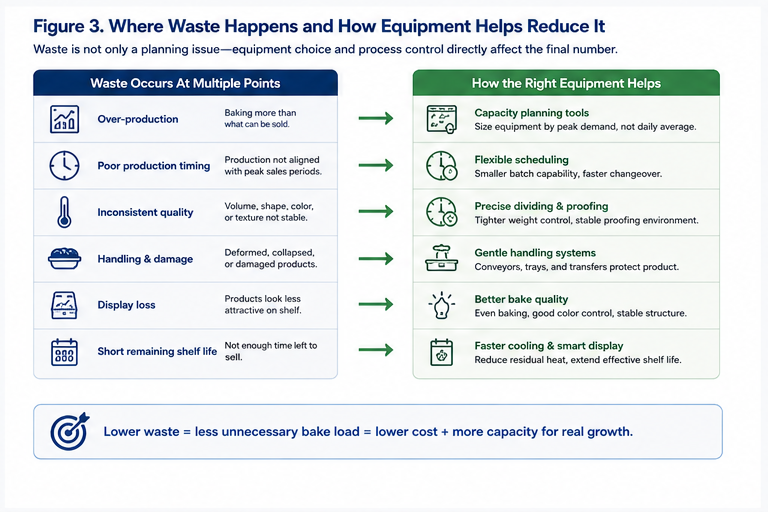
Shrink is often treated as a merchandising problem after production is finished. Operationally, it starts much earlier: oversized batches, inaccurate portions, long changeovers, late-day overproduction and a menu that forces too many low-volume SKUs through the same bottleneck.
Observed signal | Likely cause | Better response |
|---|---|---|
High late-day markdowns | Batch size or cutoff rule is too aggressive | Reduce batch size, use bake-off for the long tail, tighten last-bake rules |
Weight giveaway | Manual or unstable portioning | Validate divider accuracy and piece-weight sampling |
Stockouts during peaks | Capacity exists daily but not inside the peak window | Re-size by trays/hour and protect peak slots for core SKUs |
Frequent rework | Too many settings or poor standardization | Reduce process variants and use fixed settings cards |
Waste after SKU expansion | New products created new trays, proof or bake programs | Require new SKUs to reuse an existing production path where possible |
For a deeper operating framework, use the supermarket bakery waste-reduction guide to separate demand forecasting, batch sizing, replenishment and markdown causes before buying more equipment.
Match Equipment Bundles to Store Archetypes

A chain should not force the same equipment package into every footprint. Standardization works better when the business standardizes a small number of store archetypes and gives each archetype a fixed equipment, utility and spare-parts package.
Store archetype | Production role | Typical equipment bundle | Primary KPI |
|---|---|---|---|
Convenience / small footprint | Bake-off and finish | Convection oven + compact proofer + refrigeration | Replenishment speed per labor-hour |
Standard supermarket | Hybrid production | Mixer + divider/rounder + proofer + convection/deck oven | Peak trays/hour and shrink |
Flagship | Scratch-led differentiation | Larger mixer + forming + proofing + deck/rotary capacity | Consistency across larger SKU mix |
Central-kitchen supported | Finish and display | Cold holding + proof/finish + oven | On-time replenishment and store simplicity |
For a compact bake-off corner, a 10-tray commercial convection oven and a commercial bakery proofer are examples of equipment categories to size from the peak tray requirement—not default bundle items.
For scratch production, the same logic applies to the spiral mixer, dough divider/rounder and oven: each station must support the same saleable production rhythm after normal operating losses.
Scale Private Label Without Multiplying Complexity
Private label should increase control, not create a different operating system for every store. Before rollout, freeze the critical product specifications and build a chain kit that operators and maintenance teams can actually repeat.
One approved equipment bundle per store archetype.
One settings card for each oven/proofer program and product family.
A spare-parts list with wear parts identified by machine and model.
A product acceptance sheet covering weight, dimensions, color and pack count.
A change-control rule: new SKUs should reuse existing trays and process programs unless the business case justifies new complexity.
Build the Supplier RFQ Around Measurable Capacity and Acceptance Tests
A useful supermarket bakery quotation starts with the production problem, not a catalog request. Give every supplier the same demand and operating assumptions so price differences can be separated from configuration differences.
List the top SKUs, saleable pieces per day and the busiest replenishment window.
State the operating model for each store archetype: scratch, bake-off or hybrid.
Provide effective production hours, tray format, available space and utilities.
Define current and target waste where the equipment decision is expected to improve yield or throughput.
Require the supplier to state the bottleneck, real operating assumptions, exclusions and acceptance-test method.
During FAT or commissioning, test the actual bottleneck at the agreed tray format and production rate. Record piece-weight distribution where portioning is involved, proofing occupancy, oven recovery, cooling/packing flow and the effect of normal loading delays. A machine that passes a no-load demonstration has not yet proven the supermarket production plan.
Use the planner above to generate a decision-ready brief. The RFQ, email and WhatsApp actions only appear after the production assumptions have been calculated, so the supplier receives the operating basis with the enquiry.