Our Baking Products
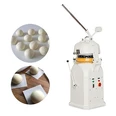
Semi-Auto 30pcs/8S Dough Divider Rounder | 30 to 100g Dough Ball Machine
Model:
Semi-Auto 30

POWER
0.75KW
380V/220V
VOLTAGE

385 KG
N.Weight

30-100 G/PCS
Capacity

Electric
Energy

Power source
Electric
Shipping Port
Weight
Material
Stainless Steel
550x720x1350 MM
Functions
Size
Capacity
Certifications
CE/SABS/GSO/ISO
Made in China
Place of Production
Price
Guangzhou China
385 KG
30 PCS/8S
30-100 G/PCS
$500-$16,000
Specification
Semi-auto 30pcs commercial dough divider rounder
What is this machine for? Semi-Auto 30 is built for production rooms where the real bottleneck is the manual step of cutting dough and rounding dough balls. It combines portioning and rounding so your downstream proofing and baking become more stable and less dependent on who is on shift.
This is a semi-automatic workflow, meaning the operator is still part of the cycle (loading dough and handling output), but the divide and round action is machine-driven. That is why it is popular in bakeries and central kitchens that want efficiency without the complexity or cost of a fully automatic line.
Where the 30pcs format fits best
30pcs is a practical format when your products mainly sit in the mid-range weight window (30 to 100g). Typical buyers choose 30pcs when they want:
More pieces per cycle than 16pcs (higher output)
Larger piece weight capability than many 36pcs small-piece setups
One machine that can cover both standard buns and pizza dough balls without constantly fighting the weight range
Common products
Buns and rolls: milk buns, dinner rolls, small bread rolls, English muffins
Pizza dough balls: consistent portioning for predictable fermentation and stretching behavior
Small pastry dough balls: only when your dough style suits rounding and release
Output planning that is honest
The listed cycle is 30 pcs per 8 seconds. That number is the machine action speed, not the whole station speed.
In real production, station throughput is limited by loading rhythm, dough handling, and how you collect balls (trays, dough boxes, conveyors).
A practical planning method:
Theoretical machine rate = (30 pieces ÷ 8 seconds) x 3600 = 13,500 pieces per hour
Real station utilization is typically a fraction of that due to loading, release, tray change, and dough condition
If you design the station for smooth loading and fast tray handling, you will get a stable, repeatable output without chasing unrealistic headline numbers
If you want a more accurate estimate for your client page, define it as:
Estimated output per hour = 13,500 x utilization factor
Use a utilization factor based on your workflow layout (for many bakeries, 0.35 to 0.60 is more realistic than 1.00)
Description
More Information
How it works with other equipment in a complete line
This section is the main differentiator from generic supplier pages. Buyers searching for a divider-rounder are usually evaluating the whole station, not only the machine.
Line A: bun and roll production station
Spiral mixer or planetary mixer
Dough rest on bench (relax dough, improve division quality)
Semi-Auto 30 divider rounder (divide plus round)
Short rest or intermediate proof (stabilize the ball surface)
Final shaping (optional, depends on bun style)
Proofer (final fermentation control)
Baking oven (convection for buns, deck for mixed products, rotary rack for batch output)
Cooling and packing
Why this matters: a consistent dough ball improves proofing uniformity and reduces tray variation, so your oven becomes easier to run at stable bake times.
Line B: pizza dough ball room (central kitchen or multi-store supply)
Spiral mixer
Dough rest
Semi-Auto 30 divider rounder (portion and round)
Dough boxes (label by weight and time)
Refrigerator or retarder schedule (cold fermentation control)
Store use: stretching or sheeting, then bake
Why this matters: pizza dough ball size consistency directly affects fermentation speed and extensibility. Standardizing the ball improves daily service stability.
Line C: mixed production in one shift (buns plus pizza)
Use one divider-rounder station to produce a standardized ball, then split output into two paths:
buns to proofing and baking
pizza balls to boxing and cold fermentation
This is one of the strongest reasons to choose the 30pcs format because it covers a common shared weight window.
Key buying points that match supplier search intent
Weight range fit first, then piece count
If your products sit mostly in 30 to 100g, 30pcs is usually the cleanest match. If you are consistently heavier, consider 16pcs. If you are consistently smaller, consider 36pcs.Station layout beats machine speed
You will gain more real output from improving loading and tray handling than from chasing cycle-time claims.Dough condition drives release quality
Hydration, oil content, inclusions, and dough temperature affect how cleanly the dough divides and how well it rounds. A good supplier should discuss this before quoting.Electrical compatibility
Confirm local voltage and phase early (220V vs 380V). This avoids friction at installation time.
Procurement checklist (what to confirm before ordering)
Your main products and target piece weight (confirm it stays in 30 to 100g)
Dough type and condition: lean or enriched, hydration level, inclusions (raisins, olives, etc)
Your daily output target and peak-hour requirement
Power standard: 220V or 380V, and local frequency
Space plan: the machine footprint is 550 x 720 mm, but you also need infeed rest table space and outfeed tray or dough-box space
What is included: confirm dividing plate set, rounding components, and whether spare parts are included
Downstream match: proofer capacity and oven throughput so the divider-rounder does not become the only fast step
FAQ
Is this machine fully automatic?
No. It is semi-automatic. The operator loads dough and manages output, while the machine performs the divide and round action.Does it replace hand rounding?
It removes most hand rounding labor because rounding is part of the machine cycle. Operators mainly handle loading and collecting.Can it handle sticky dough?
It depends on dough hydration, oil content, dough temperature, and how you manage dusting and rest time. For very sticky dough, confirm your recipe details with the supplier before final model selection.Should I choose 30pcs or 36pcs?
Choose 30pcs when your products are mainly 30 to 100g and you want stronger mid-weight coverage. Choose 36pcs when your products are consistently smaller and you want more pieces per cycle.Should I choose semi-auto 30pcs or full auto 30pcs?
Choose semi-auto when you want a strong productivity step-up with operator control and simpler workflow. Choose full auto when you want deeper labor reduction and your production is standardized enough to justify higher automation.