Central Kitchen Bakery Equipment: Shift Planning, Redundancy & Distribution
A central kitchen does not fail like a single bakery. One missed mixing cycle, oven outage, cooling bottleneck or late truck can affect every outlet at the same time. That is why equipment sizing has to start with dispatch deadlines and recoverable service, not a catalogue speed.
This guide shows how to turn outlet demand into a shift plan, identify the real constraint, decide where redundancy is justified, and choose a distribution format that outlets can execute consistently.

How to plan central kitchen bakery equipment
Short answer: plan backward from the busiest dispatch cutoff. Convert outlet demand into pieces, kilograms, trays or racks due by route; calculate effective capacity after cleaning and changeovers; protect priority demand with redundancy; then validate the cold chain and one-failure recovery plan.
Consolidate demand by outlet, SKU, daypart and dispatch route.
Translate demand into the unit that loads each process: kg of dough, pieces, trays, racks, packs or pallets.
Build the busiest shift backward from truck departure, including cooling, packaging, sanitation and changeovers.
Size redundancy around the amount of priority demand you must still recover after a failure.
Validate the complete system with real recipes, route delays and outlet finishing conditions.
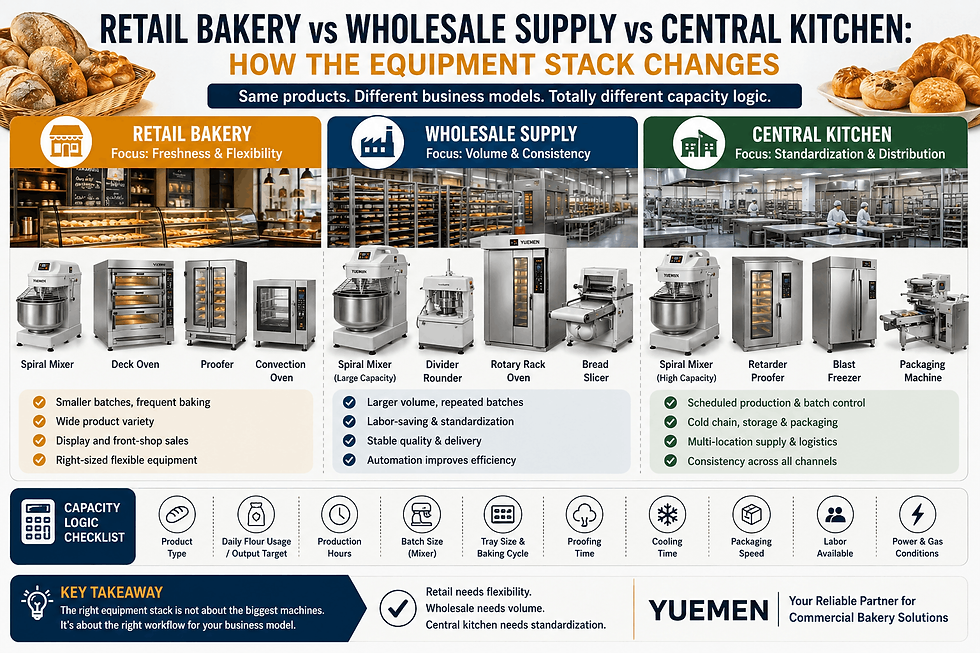
If you are still deciding whether production should remain in stores or move centrally, compare the equipment logic in our retail vs wholesale vs central-kitchen equipment stack guide.
1. Convert outlet demand into one production load
Start with the demand that must physically leave the building, not annual sales. For each outlet and SKU, record normal demand, peak uplift, required delivery window and whether the product leaves fresh, chilled, frozen or par-baked. A central kitchen serving twelve outlets may have enough daily capacity and still miss service if 60% of the volume is due before the first truck.
Useful first calculation: peak daily pieces = outlets × average pieces per outlet × (1 + peak uplift). Then multiply by the share due before the busiest dispatch. That second number is the load your shift actually has to protect.
Use the unit that exposes the bottleneck
Different machines should not be compared with one generic capacity number. Mixing may be kg/hour, dividing pieces/minute, baking racks/hour, cooling racks/hour and packaging packs/minute. Convert them to saleable output for the same product mix. The lowest effective stage determines the line, even when every upstream machine looks oversized on paper.
2. Build the busiest shift backward from dispatch
Fix the truck departure time first. Subtract loading and verification, route staging, packaging, cooling, baking, proofing, forming, mixing and ingredient preparation. Then subtract the time that brochures usually ignore: preheat, allergen changeover, cleaning, minor stops, staff breaks and quality release.
A line rated at 2,000 pieces/hour is not a 2,000-piece/hour system if only 75% of the window is productive and saleable yield is 95%. Effective output in that example is about 1,425 saleable pieces/hour. Use effective numbers for capital decisions.

Model the busiest dispatch shift
3. Design redundancy around service recovery

Redundancy does not mean buying two of everything. It means knowing how much priority demand remains recoverable when a critical asset is unavailable, how long repair takes, and whether production can move to another machine, shift or site.
Failure point | Weak design | Stronger recovery logic |
|---|---|---|
Mixer | One oversized mixer | Two usable batch paths, verified cross-loading, and critical spares |
Oven | One chamber carries all volume | Parallel ovens or multiple independent chambers that preserve partial output |
Proof / cooling | No controlled buffer | Defined rack buffer with maximum hold time and product limits |
Packaging | Single automatic lane | Manual bypass or second lane for priority SKUs |
Refrigeration | One undivided cold system | Zoning, alarms, recovery procedure and protected priority inventory |
Set a recovery target before choosing the backup
Define the central kitchen bakery equipment SKUs and outlets that must still be served during a disruption. Then state the recovery window in hours. A backup that can make 50% of normal volume may be sufficient if it protects 100% of priority products; a full duplicate can still be inadequate if both machines depend on the same utility, proofer or packaging bottleneck.
4. Choose the distribution format before final equipment sizing

The same menu can create very different central-kitchen equipment lists depending on where the last production step happens. Decide the product state at dispatch before you finalize ovens, blast freezers, cold rooms, proofers or outlet equipment.
Distribution format | Central-kitchen load | Outlet responsibility |
|---|---|---|
Fresh finished | High baking, cooling, packaging and dispatch pressure | Receive, display and sell inside a short quality window |
Par-baked | Partial bake plus controlled cooling/freezing | Finish-bake to a standardized program |
Frozen dough | Mix/form plus freezing and frozen storage | Thaw/temper, proof and bake |
Frozen par-baked | Bake, cool, freeze and frozen storage | Thaw/finish with less process variability |
Chilled ready-to-bake | Tight chilled handling and shelf-life control | Bake within defined time and temperature limits |
For outlet-side consistency, waste and finishing capacity, use the supermarket bakery equipment guide as a useful check on what the receiving store still has to execute.
5. Protect sanitation, utilities and material flow

Centralization concentrates risk. Electrical load, gas, refrigeration, ventilation, drainage, compressed air and water should be modeled by simultaneous operation during the busiest window, not by simply adding nameplates. The layout should let raw ingredients, finished product, waste, staff and service technicians move without creating uncontrolled crossings.
Include sanitation and allergen changeover in the production clock.
Provide maintenance access without blocking the complete room.
Separate raw and ready-to-eat movement where the process requires it.
Design cold-room recovery and temperature alarms as production controls, not building extras.
Reserve expansion space only where utilities, drainage and material flow can expand with it.
Large rack equipment makes these constraints visible. A 32-tray electric rotary oven needs more than the machine footprint: rack travel, door swing, exhaust, service clearance and loading traffic all affect usable capacity.
6. Qualify the supplier for uptime, not only purchase price
A central kitchen turns a supplier problem into a network problem. Ask who owns configuration control, drawings, electrical specifications, spare-parts lists, commissioning, remote diagnosis and warranty coordination across the complete line. Test real dough and representative batch sizes whenever possible rather than accepting a no-load demonstration.
The verification controls in our industrial bakery equipment supplier guide are especially important when several machines must operate as one production system.
Confirm the exact motor, control, heating and safety configuration before production.
Define which wear parts and critical spares ship with the line.
Agree on factory acceptance tests using measurable output and quality criteria.
Require operating, maintenance and electrical documentation that matches the delivered machines.
Define escalation ownership for a multi-machine fault instead of letting suppliers blame adjacent equipment.
7. Commission the system with failure tests
Commissioning should prove the operating model, not only that each machine turns on. Run the representative product mix through a normal shift and a peak shift, then deliberately test the assumptions that would hurt the network most.
Run a 10–15% demand uplift without extending the dispatch cutoff.
Take one critical mixer, oven, cooling or packaging path out of service and execute the recovery plan.
Hold a route for 60–90 minutes and check product quality, temperature and outlet instructions.
Measure yield, waste, downtime and rejection by batch instead of relying on total pieces produced.
Verify that cleaning and allergen controls still fit inside the modeled capacity window.
Approve the system when priority demand can be produced and released inside the defined recovery window. Maximum brochure speed is not a commissioning criterion.
What the final central-kitchen equipment plan should contain
Outlet and SKU demand model with peak assumptions and dispatch windows.
Shift schedule built backward from the busiest truck departure.
Effective capacity at each process stage and the identified constraint.
Redundancy map showing retained capacity and protected priority products.
Distribution-state and cold-chain assumptions for every product family.
Utility, sanitation, access and material-flow requirements.
Factory and site acceptance criteria plus the spare-parts plan.
A live capacity model that is updated when outlets, menus, routes or cycle times change.
A central-kitchen plan is not finished until the team can answer one practical question: what happens to the first dispatch if the busiest mixer, oven or cold-room path stops at 03:00? If the answer is specific, timed and testable, the equipment plan is becoming operational rather than theoretical.