Supermarket Bakery Waste Reduction: Forecasting, Production and Freshness
Table of contents
Supermarket bakeries reduce waste by tracking losses by product, producing in smaller batches, adjusting later production to actual sales and marking down surplus while it still has value.
Simply baking less is not enough. Production cuts may reduce discarded products but also create empty displays and lost sales. The objective is to improve sell-through without weakening the freshness and availability that attract customers to the bakery.
Supermarket Bakery Waste Reduction: Where Supermarket Bakery Shrink Comes from
Bakery shrink includes more than unsold bread. It may come from:
Overproduction and expired products
Markdowns
Inaccurate portion weights
Mixing, proofing or baking failures
Damage during cooling, packaging or display
Labeling and inventory errors
Unrecorded samples, donations or internal use
Record these losses separately. Bread left unsold because too much was baked needs a different solution from bread rejected because it was underweight or poorly proofed.
Bakery is one of the more difficult supermarket departments to control. Historical FMI figures reported bakery shrink of 8.5%, compared with 3.1% across the total store. More recent research from Wageningen University found that bread, part-baked bread and pastries accounted for 30.6% of food losses by weight among participating Dutch supermarkets in 2025.
However, bakery products also achieved the largest reduction since the study began. Waste is not an unavoidable fixed cost.
Measure Bakery Waste by Product and Time
A single monthly shrink percentage does not reveal what needs to change.
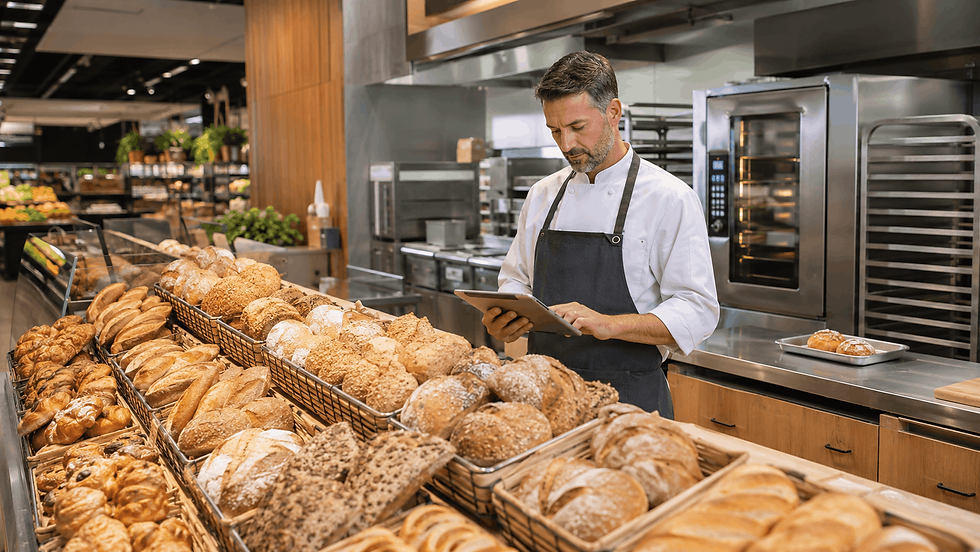
Record losses by SKU, weekday and production time. A simple bakery waste report can include:
Product | Produced | Full-price sales | Markdowns | Waste | Main reason |
Baguette | 120 | 96 | 14 | 10 | Overproduction |
Croissant | 80 | 68 | 8 | 4 | Stale |
Sandwich loaf | 60 | 57 | 0 | 3 | Packaging damage |
Calculate shrink consistently:
Bakery shrink rate = Value of bakery losses ÷ bakery sales × 100
The loss can be valued at cost or retail price, but the same method must be used across stores and reporting periods. The ECR Retail Loss Group provides a detailed framework for consistent retail shrink measurement.
Start with the ten products creating the highest loss value. Track stockouts at the same time. A product with no waste may still be underproduced and losing sales.
Reduce Bakery Waste with Smaller Production Waves
One large morning bake commits most of the day’s inventory before actual demand is known.
A more responsive supermarket bakery production plan divides the day into several waves:
Opening display
Mid-morning replenishment
Lunch production
Afternoon replenishment
Limited evening top-up
Later batches should normally be smaller because they have less time to sell. Morning production can follow the daily forecast; afternoon production should be adjusted using actual sales.
A supermarket does not need advanced software to begin. A production sheet can compare current sales with the normal weekday sales curve before another batch is approved. Larger operations can connect production planning to live POS data.
Not every product needs the same availability target. Signature bread and high-volume items may need to remain available longer. Slow-moving specialty products should not be replenished late in the day unless current sales justify another batch.

Control Display Stock and Product Range
A large display often holds more short-life inventory than the bakery can sell. The answer is not an empty table, but a display designed to look complete with fewer products.
Practical options include:
Smaller or shallower baskets
Dividers inside large displays
Tiered presentation
More frequent replenishment
Smaller display zones later in the day
Consolidating remaining products before closing
Display standards should define presentation rather than require a fixed number of units throughout the day.
The product range should also be reviewed. Several similar breads can divide the same customer demand while each requires its own minimum display quantity. A slow seller should remain only if it delivers a strong margin, serves a distinct customer group or supports a clear seasonal or promotional purpose.
Use Markdowns Before Products Lose Their Appeal
Markdowns recover part of the product value, but they should not become the bakery’s answer to routine overproduction. Timing matters. Products discounted after the main customer traffic has passed may still become waste. An earlier, smaller discount can sometimes recover more revenue.
A bakery markdown strategy may include:
A first discount while the product remains attractive
A deeper discount near the end of its selling window
Multipack or cross-category bundles
Loyalty-app offers
Surplus boxes
Donation after commercial recovery options are exhausted
Avoid discounting the same products at the same time every day. Regular customers may learn to delay purchases, replacing full-price sales with markdown sales.
Review markdown revenue together with full-price sell-through and final waste. If waste falls only because more products are being discounted, the bakery has not necessarily improved its margin. The ECR Retail Loss food-waste report explains why retailers should balance waste reduction with on-shelf availability rather than optimize either measure alone.
How Bakery Equipment Affects Shrink Control
Production planning cannot fully solve a system that forces oversized batches. When selecting supermarket bakery equipment, maximum hourly output is not the only capacity figure that matters. Store-level bakeries should also consider minimum usable batch size.
Ask:
Can the mixer handle smaller replenishment batches efficiently?
Can the divider maintain consistent portion weights?
Can the oven bake partial loads economically?
Are settings easy to repeat across shifts?
Are changeovers fast enough for several daily batches?
Do the mixer, proofer and oven capacities match?
An oversized mixer can encourage overproduction. An inaccurate divider causes ingredient giveaway, inconsistent yields and underweight rejects. Poor oven control creates waste even when the correct quantity has been produced.
The equipment must also work as one system. A high-output divider is of limited value if the proofer or oven cannot accept its output. The resulting bottleneck creates racks of work in progress and pushes employees to produce earlier than necessary.
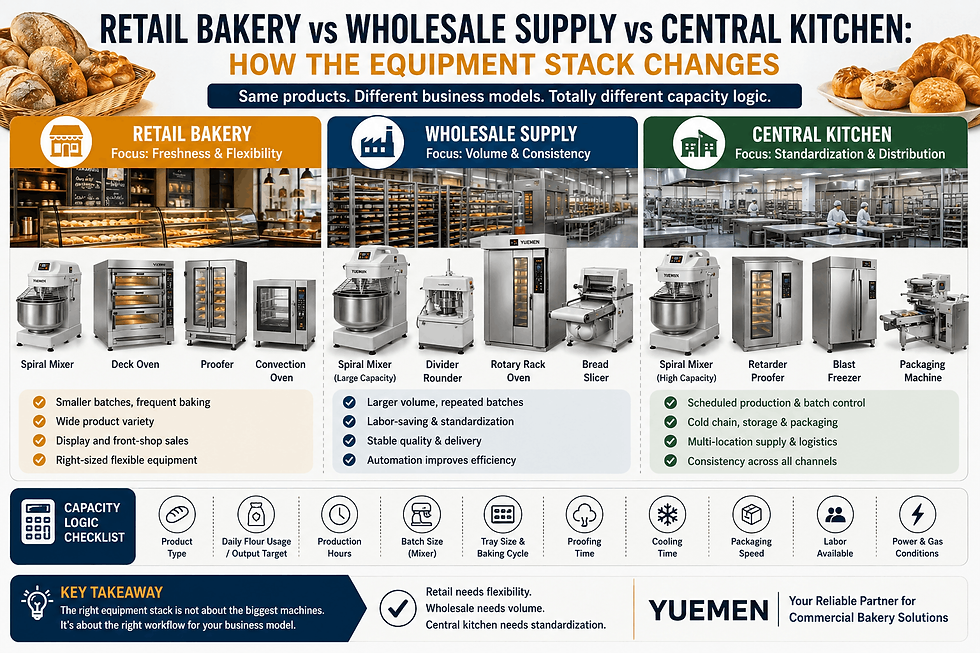
The best configuration depends on whether the store uses scratch production, frozen dough, par-baked products or a central kitchen. Yuemen’s guide to retail bakery, wholesale and central kitchen equipment compares the equipment requirements of these production models.
A Practical Supermarket Bakery Waste Reduction Routine
Begin with a controlled test:
Identify the ten products creating the highest waste value.
Record when each product is produced and sold.
Split large morning batches into smaller production waves.
Reduce late batches of slow-moving products.
Adjust display size as customer traffic falls.
Apply markdowns before products lose visual appeal.
Review waste, markdown revenue and stockouts together.
Check whether equipment batch sizes support the new plan.
Run the test for several weeks. Compare gross margin and full-price sales, not only discarded units. If waste falls but stockouts rise sharply, production has been cut too far. If markdowns remain high, the bakery is probably still producing too much or producing too early.
Lower Waste Without Sacrificing Freshness
The target is not zero waste. A bakery that never has unsold products may be underproducing and losing sales.
The practical target is the lowest sustainable shrink rate that still protects freshness, product availability and gross margin. Most supermarket bakeries should begin with three changes: measure waste at SKU level, produce in smaller waves and reduce unnecessary display inventory. Equipment must support that operating model. If a mixer, divider, proofer or oven makes smaller replenishment batches impractical, forecasting alone will not correct the problem.
For a new supermarket bakery or equipment upgrade, send Yuemen your product list, unit weights, daily output, opening hours and peak selling periods. We can compare the production schedule with the required mixer, divider, proofer and oven capacities before recommending a configuration. WhatsApp / WeChat: +86 188 1945 9649