Private Label Buns and Rolls: Equipment, Consistency and Scale-Up Playbook
Updated: Aug 30
Private label buns and rolls are not difficult because the product is unfamiliar. They are difficult because a retailer or foodservice buyer expects the same weight, size, softness, color and pack performance across thousands of pieces.
The equipment plan therefore has to start with the SKU specification and acceptance tolerances. Mixer size, divider accuracy, proofing capacity, oven rhythm and packaging only make sense after the product target is measurable.
Private Label Buns and Rolls Start with the Product Specification

Short answer: define what an acceptable bun looks and performs like before choosing equipment. A private-label specification should turn subjective words such as “soft,” “uniform” or “premium” into measurable targets that production can hold and a supplier can test.
Specification | What to define | Why it affects equipment |
|---|---|---|
Piece weight | Target grams and acceptable tolerance | Drives divider accuracy, dough yield and bake uniformity |
Diameter / height | Finished dimensions and shape limits | Connects rounding, proofing, tray spacing and oven profile |
Crumb / softness | Texture target and holding window | Depends on mixing, proofing, baking and cooling |
Color / surface | Color range, shine, seeds or toppings | Affects proof condition, oven control and topping application |
Pack format | Pack count, orientation and damage limits | Sets cooling, handling and packaging requirements |
Shelf life | Target days and storage condition | Depends on hygiene, cooling, film, sealing and formulation |
This is the key difference between a private-label project and a generic bread line: the buyer is not purchasing “buns.” The buyer is purchasing a repeatable specification.
Build a Consistency Chain, Not a Collection of Machines
Most commercial variation is created upstream and amplified downstream. When dough temperature moves, the divider, proofer and oven all receive a different product. When piece weight moves, color, moisture loss, pack appearance and cost move with it.
1. Dough temperature and mixing
Control ingredient temperature, water addition, usable mixer batch size and mixing endpoint. Richer formulas such as brioche-style buns are especially sensitive because fat and sugar change development time and dough temperature.
2. Dividing and rounding
Piece-weight accuracy is a critical quality attribute, not merely a mechanical specification. Check the divider across the beginning, middle and end of a batch. Our volumetric dough divider guide explains why dough condition and product range matter as much as headline pieces per hour.
3. Proofing and baking
Proofing must deliver a repeatable dough condition to the oven. Chamber capacity, temperature, humidity and dwell time have to match line rhythm. Use the commercial bread proofer sizing guide when comparing proofing capacity to tray flow instead of treating the proofer as a standalone cabinet.
The oven then has to hold the specified color, softness and internal bake across normal loading patterns. An oven that produces one good tray during a demonstration has not yet proved commercial consistency.
4. Cooling and packaging
Cooling is part of shelf-life control. Products packed too warm can create condensation and texture problems; products left exposed too long increase handling and hygiene risk. Packaging capacity must therefore be synchronized with cooling release, not added as an afterthought.
Choose Equipment from the Required Production Rhythm

Stage | Capacity basis | What to verify |
|---|---|---|
Mixer | Usable kg/batch × batches/hour | Dough temperature, mixing endpoint, batch transfer time |
Divider / rounder | Saleable pieces/hour | Weight tolerance across real dough and full batch |
Proofer | Trays or pieces in dwell time | Temperature, humidity, loading rhythm and recovery |
Oven | Trays or racks/hour | Color and internal bake at normal loading |
Cooling | Trays/racks released per hour | Product temperature before packing and handling time |
Packaging | Packs/cases per minute | Seal quality, pack count, damage and changeover |
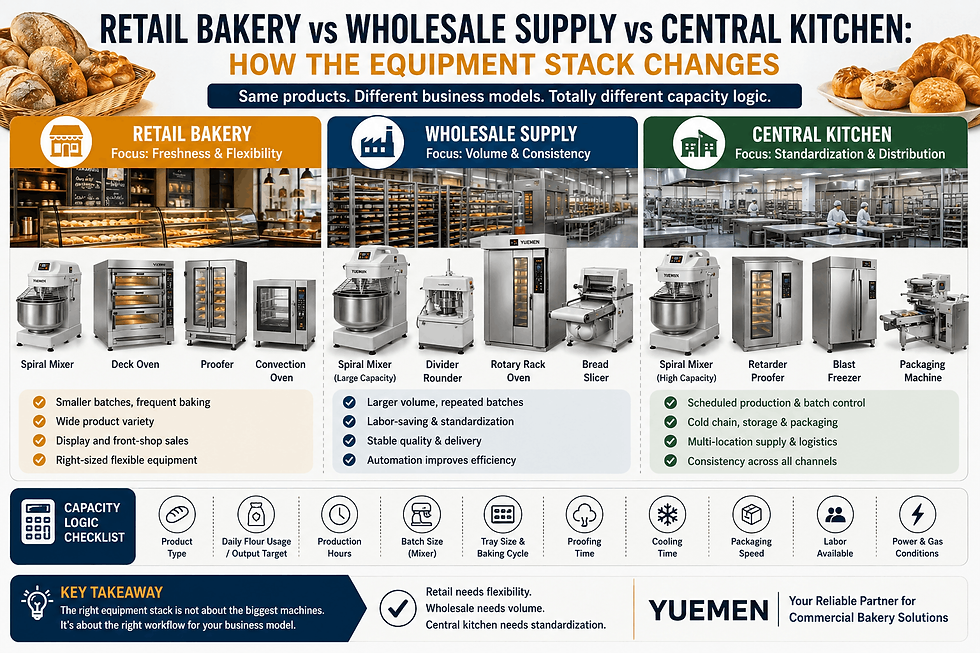
A supermarket or central-kitchen project often needs more buffer and stricter synchronization than a small bakery. Compare the broader system logic in the supermarket bakery equipment guide and the central kitchen shift and redundancy guide.
Scale Up from a Trial Batch Without Losing the Product

A successful 200-piece trial does not prove a 12,000-piece shift. At scale, dough waits longer, trays queue, proofing chambers cycle, ovens recover between loads and packaging creates a downstream constraint. The process has to be validated as a time-based system.
Use effective production hours, not paid shift hours. Subtract cleaning, preheat, product changeover, minor stops and quality release. Then add a realistic operating buffer. The required protected rate is the saleable demand divided by effective hours, plus that buffer.
Build a production brief from your SKU
Validate Commercial Consistency with a CTQ Sampling Plan

A factory acceptance test should sample the line over time, not select the best-looking pieces. Define the critical-to-quality measurements before testing.
Sample point | Measure | What it reveals |
|---|---|---|
Start of run | Piece weight, dough temperature, shape | Setup and first-batch stability |
Middle of run | Weight distribution, proof height, oven color | Drift as the line reaches normal rhythm |
End of run | Weight, dimensions, crumb, surface condition | Batch-end consistency and dough-condition effects |
After cooling | Product temperature, softness, damage | Readiness for packaging |
Packed product | Count, seal, appearance, finished weight | Retail / case compliance |
Record averages and spread, not only pass/fail examples. Tight private-label specifications need evidence that the process remains centered, not evidence that one acceptable bun exists.
Packaging and Shelf Life Are Part of the Production Line
Pack count, bag dimensions, film, sealing method, coding and case packing affect the equipment flow and commercial result. Shelf-life targets should be validated under the real route-to-market condition rather than assumed from the recipe alone.
Define the product temperature at which packaging can begin.
Include seal integrity and pack damage in acceptance testing.
Test the intended storage and distribution condition, not only the bakery environment.
Link shelf-life complaints back to cooling, hygiene and packaging data as well as formulation.
Buyer Model Changes the Acceptance Criteria
Buyer | Highest-priority controls | Typical equipment implication |
|---|---|---|
Supermarket private label | Pack appearance, count, shelf life, visual uniformity | Stable high-volume line plus controlled packaging |
Distributor supply | SKU flexibility, pack changes, mixed demand | Changeover discipline and practical capacity buffer |
Foodservice / QSR | Diameter, slicing, handling and holding performance | Tight dimensional control and fit-for-use validation |
The same nominal bun can require a different production setup when the acceptance criteria change. That is why buyer model belongs in the equipment brief.
Put the Specification and Test Method into the Equipment RFQ
A supplier cannot design a reliable line from “12,000 buns per day” alone. The RFQ should define the product, tolerance, batch logic, tray format, effective hours and acceptance test so quotations describe the same job.
Product type, formula class and target piece weight.
Piece-weight and finished-dimension tolerances.
Daily saleable output and effective production hours.
Tray size, pieces per tray and proofing / baking format.
Pack count, packaging format and shelf-life target.
Available utilities, floor space and labor assumptions.
Factory acceptance test using the buyer’s product and measurable CTQs.
Required spare parts, documentation, training and after-sales responsibility.
When quotations are vague, use the bakery equipment quotation red-flags guide to separate a catalog quote from a real production plan. For multi-machine projects, the industrial bakery equipment supplier guide is useful for checking who owns integration and commissioning.
Make the Scale-Up Decision from Production Evidence
The right buns-and-rolls line is not the one with the largest advertised output. It is the line that can hold the buyer’s specification through the full production window, recover from normal variation and release the required packs on time.
Before finalizing equipment, send the supplier one product specification, one capacity basis and one acceptance method. If those three documents are clear, machine selection becomes much easier to compare—and much harder to fake.