Bakery Equipment Suppliers in Guangzhou: Buyer Verification Guide
Updated: Aug 30
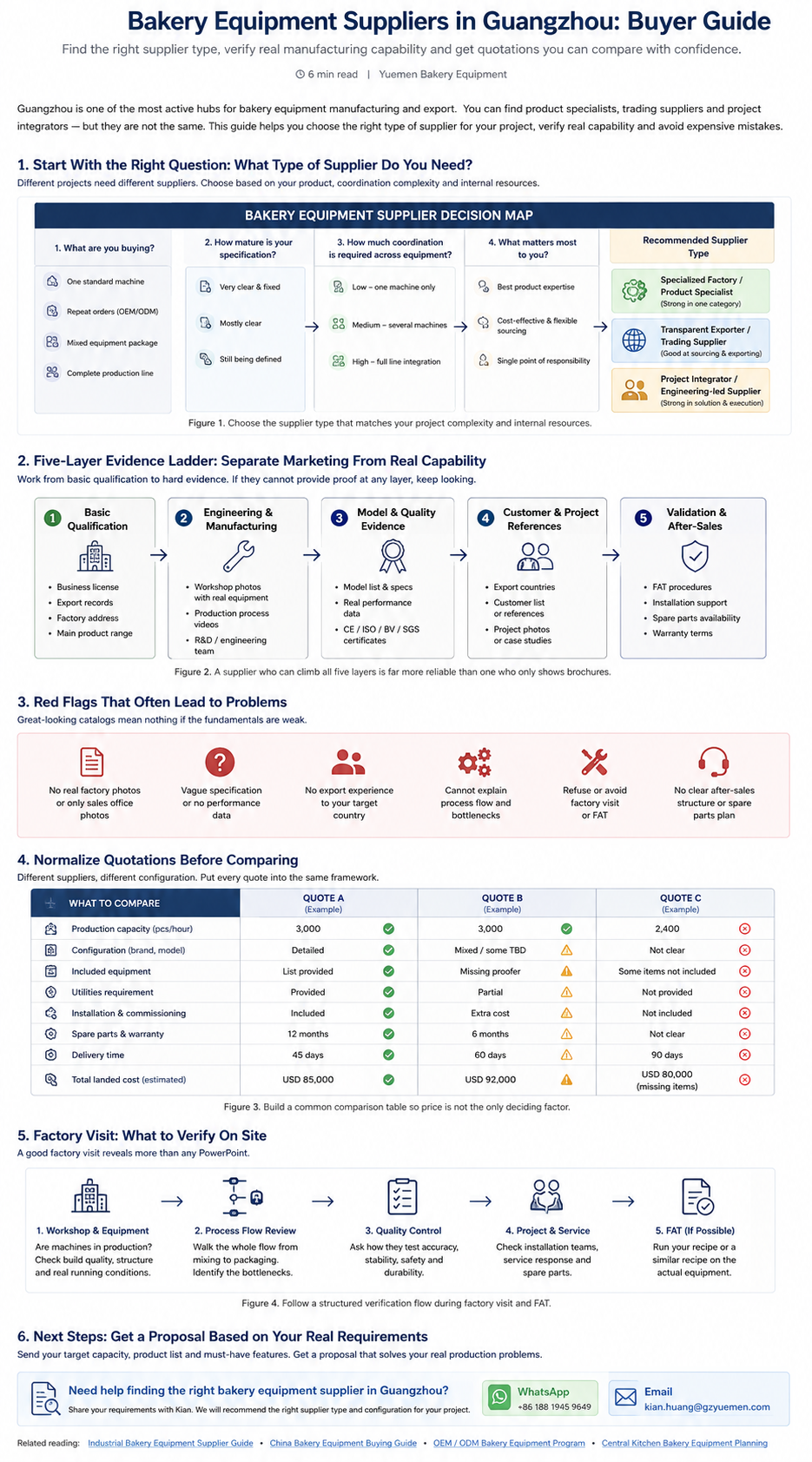
There is no single best bakery equipment supplier in Guangzhou. The right route depends on what you are buying, how complete your specification is, and how much coordination the order requires. A specialized factory may be the strongest choice for one defined machine; a transparent exporter may be better for a mixed container; a project integrator may be necessary when capacity, layout and utilities have to work as one system.
Short answer: choose the supplier role first, then verify the company. For most buyers, verification means confirming the legal entity, the exact model and manufacturing source, the final configuration, a test with acceptance criteria, and who owns packing, spare parts and warranty support.
A List of Bakery Equipment Suppliers in Guangzhou
The companies below are a non-ranked starting shortlist based on current public information. Their inclusion is not an endorsement, and the supplier role can vary by product, model and project. Use the verification framework later in this guide before approving a deposit or relying on a factory claim.
Supplier | Publicly presented focus | Where it may fit |
|---|---|---|
Guangzhou Yuemen Machinery Equipment Co., Ltd. | Commercial bakery equipment supplier and solution provider; broad bakery, kitchen and food-processing scope | Mixed equipment packages, export coordination and projects needing one commercial contact |
Guangzhou Hongling Electric Heating Equipment Co., Ltd. | Bakery equipment manufacturer; ovens, mixers, proofers and OEM/ODM bakery equipment | Oven-heavy projects, standard bakery equipment and OEM/ODM programs |
Guangzhou Zhibao Food Special Equipment Co., Ltd. | Commercial bakery equipment manufacturer with mixers, moulders, slicers, sheeters, proofers and ovens | Buyers comparing a broad standard bakery-equipment range |
Guangzhou Nicko Machinery Co., Ltd. | Bakery equipment company presenting R&D, design, manufacturing, sales and service capabilities | Bakeries, supermarkets and food factories sourcing multi-category bakery equipment |
Guangzhou R&M Machinery Co., Ltd. | Commercial bakery and food-processing equipment manufacturer with Guangzhou operations and a Foshan production base | Ovens, bakery machinery, OEM/ODM and larger production-oriented projects |
Guangzhou Astar Kitchen Equipment Co., Limited | Bakery and commercial-kitchen equipment supplier with Guangzhou factory and office presence | Mixed bakery/kitchen equipment sourcing and standard commercial machines |
Guangzhou MICBake Machinery Equipment Co., Ltd. | Bakery machinery supplier presenting R&D, manufacturing and global trade, including production-line equipment | Bread, pastry or other bakery production-line projects requiring a broader equipment scope |
Do not compare these companies only by catalogue size or quoted price. First identify which supplier structure fits your order, then verify the exact legal entity, manufacturing source, configuration, test evidence and after-sales ownership.
What Type of Bakery Equipment Supplier Do You Need?
Do not use “manufacturer” as a quality label. It only describes one possible role in the supply chain. The stronger question is: which supplier structure leaves the fewest critical responsibilities unowned for this order?
Specialized Factory
A specialized factory is usually strongest when the order is concentrated in one category and the specification is already stable. The buyer gets deeper product knowledge and may get a simpler commercial route, but must still confirm what is actually made in-house and what is sourced from partners.
Transparent Exporter or Trading Supplier
A good exporter or trading supplier adds value by coordinating several factories, controlling specifications, export documents, packing and one commercial transaction. The role becomes weak when the seller hides the source, cannot explain technical differences or simply forwards catalogues.
Project Integrator
An integrator becomes useful when machines must work as one production system. Capacity matching, utilities, layout, interfaces, FAT and one point of responsibility matter more than whether every machine comes from the same building. For larger projects, compare this with a production-flow supplier rather than comparing factory labels alone.
Order situation | Usually stronger first route | What still needs proof |
|---|---|---|
One standard machine | Specialized factory / product specialist | Exact model, configuration, test and parts support |
Repeat distributor or OEM order | Factory + export-capable commercial partner | Repeatability, branding control, documents and spare parts |
Mixed bakery equipment package | Transparent exporter or integrator | Source of each item, normalized specifications and warranty ownership |
Complete production line | Engineering-led integrator | Capacity matching, drawings, interfaces, FAT and commissioning scope |
How to Shortlist Bakery Equipment Suppliers in Guangzhou
Guangzhou is a practical sourcing base because buyers can combine supplier meetings, factory visits, logistics and export services in one region. But a Guangzhou address does not prove that every quoted machine is manufactured inside the city. Partner plants may be elsewhere in Guangdong or in another manufacturing cluster.
Build the shortlist around the product and the order structure. For one dough divider, ask who can prove performance with your dough range and piece-weight target. For a complete bun line, ask who can explain the relationship between mixer batches, divider output, proofing occupancy, oven cycle, cooling and packing. The narrower the production question, the easier the supplier is to verify.
Verify the Supplier in Five Evidence Layers
One impressive factory video is weak evidence. A safer verification process builds several layers that should all point to the same company, model and configuration.
Legal and Commercial Identity
Confirm the registered company name, business address, quotation issuer and payment beneficiary. Different names can be legitimate, but the relationship should be explained before any deposit is paid.
Exact Model and Manufacturing Source
Ask for current, model-specific photos or video showing the nameplate, control panel, internal construction and operating sequence. If the item comes from a partner factory, ask the seller to state that directly. Transparency is more useful than pretending every product comes from one building.
Configuration Control
Lock tray or rack size, usable capacity, voltage, frequency, phase, heating source, dimensions, accessories and exclusions in one controlled quotation or configuration sheet. Custom equipment should have an approved drawing or revision-controlled specification.
Factory Acceptance Test
Define what the test must prove before production starts. An oven test may include temperature rise, recovery, steam and safety functions; a mixer test may include dough load, cycle and dough temperature; a proofer test may include recovery and readings at several positions. A machine running empty is not a meaningful FAT.
Packing, Documents and After-Sales Ownership
Confirm crate dimensions, packing method, spare-parts list, manuals, wiring diagrams and the procedure for identifying replacement components later. “One-year warranty” is incomplete unless the buyer knows who diagnoses the fault, who supplies the part and how the part is identified.
Evidence layer | Ask for | Stop and clarify if |
|---|---|---|
Company identity | Business entity + payment relationship | Beneficiary cannot be explained |
Product identity | Exact model evidence + manufacturing source | Only generic catalogue photos are available |
Configuration | Final technical sheet / drawing | Key details keep changing after quotation |
Testing | Agreed FAT inputs and acceptance points | Supplier offers only an empty-run video |
After-sales | Parts route + manuals + warranty owner | Nobody owns diagnosis or part identification |
Five Red Flags Before You Pay a Deposit
The model description changes each time you ask a technical question.
The supplier refuses to show the final nameplate, control configuration or current model evidence.
An extremely broad product range is presented as one factory, but the source of individual machines is never disclosed.
The seller asks for payment before voltage, capacity basis, dimensions, accessories or exclusions are fixed.
The warranty sounds generous but there is no practical process for diagnosis, spare-parts identification or replacement.
Normalize the Quotation Before Comparing Price
A lower EXW price is not automatically the lower-cost option. First make every supplier quote the same scope, then compare price. If you are still deciding between sourcing routes, use the China direct-buying guide to separate equipment price from project risk.
Actual product and capacity basis
Included and excluded accessories
Final voltage, phase, frequency and fuel configuration
Operating, door-open and maintenance dimensions
Packing dimensions, weight and shipment scope
FAT and documentation deliverables
Warranty owner and spare-parts route
Lead time tied to an approved specification
Example: Supplier A quotes a cheaper 32-tray proofer. Supplier B quotes more but provides runner spacing, rack drawing, recovery test and the final 60 Hz component list. If the product needs more vertical clearance than Supplier A assumed, its “32 trays” may not be 32 usable positions. Price cannot be compared until usable capacity is normalized.
Plan a Guangzhou Factory Visit Around Evidence
A factory visit should verify unresolved questions, not repeat a sales presentation. Send the supplier the target models and test questions before the visit, and confirm which address is the office, showroom, warehouse and actual production site.
Match the model on the floor to the quotation and approved configuration.
Check nameplates, controls, dimensions and service clearances.
Follow one order through assembly, wiring, testing, packing and documentation where possible.
Ask who owns partner-factory items and who will handle after-sales support.
Record the remaining evidence gaps before discussing deposit timing.
Where Yuemen Fits—and Where It May Not Be the Best Fit
Yuemen is based in Guangzhou and works as a commercial bakery equipment supplier and project coordinator using both own and partner manufacturing resources. For mixed projects, the value is in identifying the source of each machine, matching production flow, normalizing the quotation and keeping one commercial line of responsibility.
That structure is not automatically the best route for every order. A buyer purchasing one standardized machine in large repeat quantities may prefer a direct specialized factory. A distributor building a branded range should also compare the requirements of an OEM/ODM bakery equipment program before choosing the commercial structure.
For a central kitchen or multi-machine project, supplier selection should also follow the production system, not just the catalogue. The central kitchen equipment planning guide shows how capacity, redundancy and dispatch windows change the equipment decision.
What to Send Before Asking for a Supplier Recommendation
A useful supplier recommendation starts with the order, not the supplier name. Prepare these inputs before requesting quotations or verification help:
Product or menu list
Target daily output and working hours
Machine categories already defined
Voltage, phase, frequency and fuel preference
Available floor plan or site dimensions
Destination country and shipment timing
Customization, OEM or branding requirements
Any quotations or model sheets already received
The correct supplier route is the one that can prove the required product, configuration and responsibilities with the fewest critical gaps before payment.


