Wholesale Bakery Equipment List: Capacity and Workflow
Updated: 6 days ago
A wholesale bakery equipment list should cover the complete route from ingredients to packed orders: storage, weighing, mixing, dough preparation, proofing, baking, cooling, slicing where needed, packaging and dispatch. Size these stages to the same product demand and delivery window.
This guide turns product demand into batch sizes, buffers and equipment interfaces for bread, buns, rolls and related wholesale products. Use representative production trials and local engineering, food-safety and building advice before finalizing a line.

Wholesale bakery equipment starts with the dispatch deadline
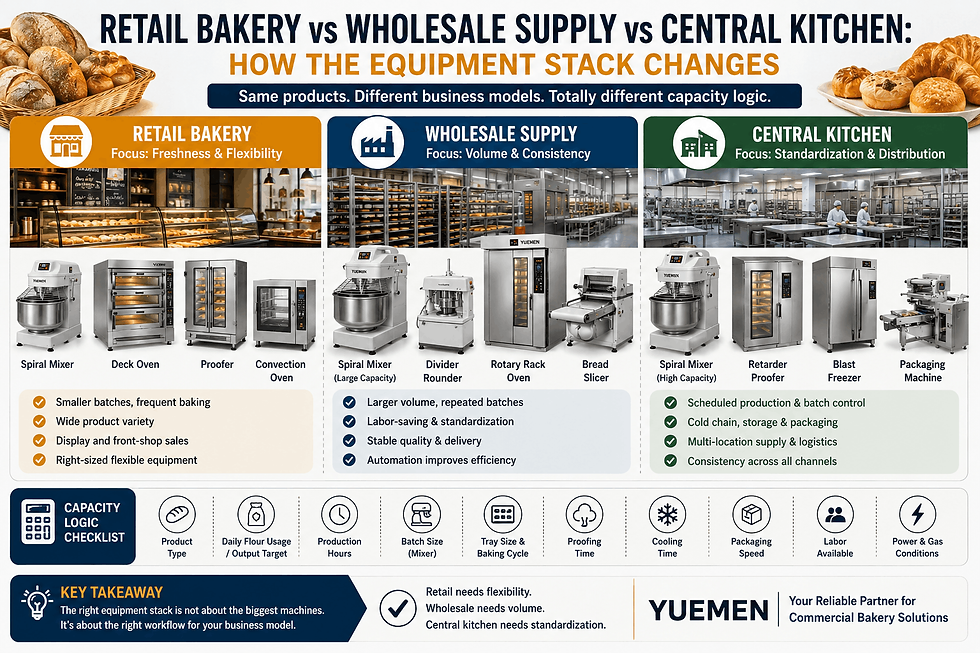
Start with orders by SKU, route and required dispatch time. Convert finished units into dough or batter demand after yield and expected loss. Group compatible products into campaigns, then work backward through cooling, baking, proofing, forming and mixing. This exposes the minutes available at each stage and the buffers needed when demand is uneven. Use the retail, wholesale and central-kitchen stack comparison to confirm that this line is solving the correct operating model.
Plan a normal day, a peak day and a disruption day. A line designed only around average volume can miss a delivery window when one oven deck, wrapper or operator is unavailable.
Equipment checklist for a wholesale bakery
Production stage | Equipment to assess | Capacity check |
Ingredient preparation | Storage, scales, worktables and ingredient handling | Ingredients ready for each planned batch |
Dough preparation | Mixer, divider and forming equipment | Dough kg per hour and accepted pieces per hour |
Proofing and baking | Proofer, racks, trays and ovens | Occupied tray positions and complete bake cycles |
Cooling and finishing | Cooling racks or conveyor, slicer where needed | Validated cooling time and acceptable finished units |
Packing and dispatch | Packaging, coding, order staging and carts | Accepted packs per minute and route deadlines |
Choose mixer size and batch rhythm together
Mixer capacity should match formula, hydration, minimum and maximum batch, mixing time, bowl discharge and the forming line’s feed pattern. Oversized batches may wait and change temperature; undersized batches can waste labor and leave ovens partially loaded. Include ingredient staging, scaling and bowl or trough movement in the cycle. A 75 kg commercial spiral mixer is one possible batch anchor, but its real fit still depends on dough type and downstream flow.
Use finished-dough weight and actual dough resistance rather than bowl liters alone. If several products share the mixer, price changeover and allergen controls into available capacity.
Balance dividing, forming and proofing as one flow
The divider, rounder, moulder, sheeter or depositor must handle the dough range without excessive damage or giveaway. Confirm piece-weight tolerance across the production run, not only at start-up. Proofing capacity follows pieces per carrier, dwell time, temperature, humidity and the loading rhythm from forming.
A long proofer can become a hidden single point of failure. Define bypass, holding and recovery procedures, and check that racks, trays or boards transfer cleanly between machines.
Calculate usable oven capacity, not catalogue trays
Usable capacity combines saleable pieces per load, cycle time, loading and unloading, recovery, product changeover and maintenance. Test color and bake loss across the actual rack or belt pattern. If products need different temperature or steam profiles, a theoretical total tray count overstates flexible capacity. The formulas in bakery production math provide a second check on tray flow and peak-hour headroom.
Compare one large oven with multiple zones or smaller units. Redundancy may matter more than peak efficiency when dispatch commitments are strict.
Treat cooling as part of packaging capacity
Cooling must bring products to the condition required for slicing and wrapping without condensation, crust damage or excessive exposure. Record product core and surface behavior using an approved quality method, ambient conditions, spacing and airflow. Count carriers or conveyor length from real dwell time at peak output.
Provide access for sanitation and avoid crossings between hot product, packaging materials, waste and finished goods. Cooling space often determines whether the oven can keep running.
Connect slicing, packaging and coding
Packaging speed should be based on acceptable packs per minute after jams, film changes, label changes, metal detection or checkweighing and operator replenishment. Confirm that sliced products are stable enough for the chosen feed and that bag or film dimensions match variation in finished product.
Link lot coding and order data to the dispatch process. A fast wrapper creates rework if labels, counts or route separation are unreliable.
Use controlled buffers before dispatch
Use small controlled buffers to decouple stages without hiding chronic imbalance. Define maximum hold time, identification, first-in-first-out rule and responsibility for release. Dispatch needs finished-goods staging by route, order verification, loading access and temperature or protection appropriate to the product.
Test the complete flow during a simulated peak. Measure when each order becomes shipment-ready rather than when baking ends.
Map utilities, access and sanitation before ordering
Build a utility schedule for every machine: electrical supply, gas where applicable, water, drainage, compressed air, exhaust, make-up air and heat rejection. Confirm connection points, peak demand and simultaneous use. Add doorway, lift, turning radius, floor loading, service clearance and a route for future removal. A balanced production calculation can still fail if the building cannot install or maintain the selected assets.
Draw people, ingredients, packaging, hot product, cooled product, finished goods and waste as separate flows. Provide safe landing areas at transfer points and enough access to clean beneath, behind and inside food zones. Include sanitation and start-up in the shift model instead of treating them as hours outside production.
Define quality gates and production data
Choose measurable release points: ingredient and dough temperature, piece weight, proof state, bake color, bake loss, cooling condition, slice quality, seal integrity, code accuracy and order count. Assign who records each result and what happens when it is outside the limit. Production data should connect the finished pack to a batch and equipment condition without requiring operators to duplicate paperwork.
Use a daily board or system that shows planned units, actual saleable units, downtime reason, waste and dispatch readiness by SKU. Review losses at the process that created them. Packaging rejects, for example, may begin with loaf shape or cooling rather than the wrapper itself.
Commission saleable output, not isolated machines
Write interface specifications between suppliers: discharge height, tray or rack format, line speed range, product orientation, buffer logic, signals, guarding responsibility and emergency-stop behavior. If several vendors are involved, name one party or integrator responsible for the complete acceptance sequence. A machine can pass its standalone test while the line fails at every handoff. Use the industrial bakery supplier guide when assigning responsibility across several equipment interfaces.
Commission with the product family, normal and peak batches, planned operators and real packaging. Measure saleable output from ingredient staging to shipment-ready goods. Record settings, changeovers, cleaning, faults and training gaps, then close them against a signed acceptance list before releasing final payment where the contract allows.
Find the first production bottleneck
Wholesale bakery equipment planning questions
What equipment does a wholesale bread bakery need?
A typical route includes ingredient storage and scales, a suitable mixer, dough dividing and forming equipment, proofing, ovens, cooling space, and packaging. Add slicing, freezing or other stages only when the product and delivery model require them.
How much cooling capacity is needed?
For a steady flow, occupied cooling positions are approximately trays released per hour × cooling time in hours. For example, 40 trays per hour with a 1.5-hour cooling stage occupies about 60 tray positions before a handling allowance. Confirm actual cooling time and product release criteria in a trial.
Use bakery production line planning to connect the stages, then compare the commercial bakery equipment catalog. Send Yuemen your products, daily orders, peak dispatch time, tray format and available utilities for a coordinated equipment review.