Bread Slicer Selection: Blade Count, Slice Thickness and Crumb Control
Bread slicing looks like a small final step. In real bakery production, it can decide whether the finished product looks clean enough to sell.
A loaf may come out of the oven with good volume, color, and texture, but poor slicing can still ruin the result. Too many crumbs inside the bag, uneven slices, torn surfaces, compressed loaf shape, and rough edges all make the bread look less fresh and less professional.
For retail bakeries, this affects the customer experience at the counter. For wholesale bakeries, supermarkets, and central kitchens, it can lead to waste, complaints, rejected batches, and returns.
That is why a commercial bread slicer should not be selected by blade count or price alone. The better question is whether the slicer matches the loaf type, slice thickness, cooling condition, daily workflow, and packaging requirement.
Bread Slicer Selection: A Bread Slicer Protects the Product You Already Made
Slicing is not just cutting. It is the last quality checkpoint before the bread reaches the customer.
Customers do not see your mixing time, moulding pressure, proofing control, or oven setting. They judge the sliced bread after the bag is opened. If the slices are clean, even, and easy to use, the product feels reliable. If the slices are ragged, crushed, or full of loose crumbs, the product immediately looks lower quality.
Poor slicing usually shows up in simple but expensive ways. The bread creates more waste during packing. Workers spend more time cleaning crumbs. Cafés complain that slices tear during sandwich preparation. Supermarkets reject products that look messy on the shelf. Customers return bread because it looks dry, broken, or poorly handled.
A good slicer helps reduce these problems, but only when it is chosen for the right bread and used at the right point in the production flow.
For sliced bread production, the slicer should be considered together with the full commercial bakery equipment setup, not as a separate machine at the end of the line.
Start with the Bread, Not the Blade Count
Many buyers ask first: “How many blades does the slicer have?” That is understandable, but it is not the best starting point.
The first question should be: what bread are you slicing? Soft sandwich bread needs clean cutting without compression. Toast bread needs regular thickness and stable slice shape. Pullman loaves need straight, uniform slices for packing. Milk bread needs gentle handling because the crumb is soft. Whole wheat and rye loaves may create more resistance. Crusty artisan loaves can produce more crumbs and blade stress if the slicer is not suitable.
The same slicer cannot perform equally well for every loaf. Loaf height, loaf width, crust strength, crumb softness, moisture level, cooling condition, and target packaging all affect slicing quality. A slicer that works well for standard toast bread may not be suitable for dense rye bread or thick café toast.
This is why slicer selection should begin with the product. Once the loaf type is clear, blade spacing, machine size, slicing speed, and workflow become easier to decide.
Blade Count Is Not the Same as Slice Thickness
Blade count is a specification. Slice thickness is the result the customer sees.
A bread slicer may have a certain number of blades, but the actual slice thickness depends mainly on blade spacing. This is where many buyers get confused. More blades do not automatically mean better slicing. The blade layout has to match the desired slice thickness and loaf size.
For standard toast and sandwich bread, fixed-thickness slicers are common because bakeries usually want the same slice size every day. Common slice thickness options may include around 10 mm, 12 mm, 13 mm, or 16 mm depending on the machine and market requirement.
For many daily toast and sandwich bread programs, 12 mm is a practical standard. It gives a familiar slice for household bread, sandwiches, toast, and packaged loaves. Yuemen’s common YMQ-31 bread slicer is typically used for 12 mm slicing, making it suitable for many standard toast and sandwich bread applications.
But 12 mm is not automatically correct for every bakery.
A café selling thick toast may need a thicker slice. A supermarket bread program may need a fixed slice count per bag. A foodservice customer may need slices that fit a specific sandwich size. A bakery selling soft milk bread may need to balance slice thickness with crumb strength. Before choosing the blade count, confirm the slice target first.

Slice Thickness Affects More Than Appearance
Slice thickness changes how the bread is used, packed, and perceived. Thin slices can work for light toast, tea sandwiches, or smaller portions. But if the bread is very soft, thin slices may tear more easily. Standard slices are usually safer for sandwich bread and packaged toast because they balance handling strength, portion size, and pack appearance. Thicker slices may feel more premium, but they reduce the number of slices per loaf and change the bag size or pack height.
A simple way to think about it:
Slice style | Approx. thickness | Typical use | Main risk |
Thin slice | 8–10 mm | light toast, tea sandwiches, smaller portions | fragile slices, easier tearing |
Standard slice | 11–13 mm | sandwich bread, toast bread, packaged sliced bread | best for many daily bread programs |
Thick slice | 14–16 mm | café toast, premium soft bread | fewer slices per loaf, different pack count |
Extra thick slice | 18 mm+ | Texas toast, specialty bread | not suitable for standard sandwich packs |
For wholesale bread, this decision is commercial, not only technical. If the slice thickness does not match the customer’s expected pack count or application, complaints can happen even when the bread itself is good.
Crumbs Usually Come from a System Problem
When a bakery sees too many crumbs, the first reaction is often to blame the slicer. Sometimes the slicer is the issue. Many times, the problem starts earlier.
Bread that is sliced too hot can compress, tear, or create a gummy cut surface. Bread that is sliced too cool or too dry can create excessive crumbs and product loss. A dull blade can make the surface rough. Weak crumb structure from poor mixing, proofing, or baking can make the loaf collapse during slicing. A loaf that does not fit the slicer properly may shift or deform.
Common causes of poor slicing include:
bread sliced before proper cooling
bread too dry at slicing
dull or poorly tensioned blades
loaf too soft for the chosen slice thickness
crust too hard for the slicer setup
poor guide or hold-down adjustment
uneven operator loading
crumb tray not cleaned regularly
unstable loaf shape before slicing
This is why cooling matters. For sliced bread, the process should not jump directly from baking to slicing. The loaf needs enough time to stabilize before it goes through the blades.
A practical flow is: baking → cooling → slicing → bagging → sealing → dispatch
If cooling is rushed, the slicer is forced to handle bread at the wrong condition. That usually shows up as tearing, compression, crumbs, or poor bagging appearance.
Blade Maintenance Is Part of Product Quality
A bread slicer does not stay sharp and clean by itself. As blades become dull, the machine may still run, but the slice quality slowly declines. The bakery may start seeing more crumbs, rougher slice surfaces, more tearing, and more cleaning work. Workers may push loaves harder to compensate, which makes the problem worse. Maintenance should be routine, not emergency repair.
The bakery should regularly check blade sharpness, blade tension, crumb buildup, guide alignment, hold-down parts, and general machine stability. Crumb trays should be cleaned before buildup starts affecting operation. Operators should also be trained not to force loaves through the slicer when the bread is too warm, too soft, or poorly positioned.
For higher-volume bakeries, blade maintenance is not a small technical detail. It directly affects waste, labor, product appearance, and customer complaints.
Slicing Must Fit the Packing Workflow
A slicer that cuts well can still create problems if it is placed badly in the workshop. The slicing station should be close to cooling and packing. Workers should not have to carry loaves across the room after cooling, then carry sliced bread somewhere else for bagging. That wastes labor and increases handling damage.
A better sliced bread workflow usually includes a clear path from cooling racks to the slicer, then to bagging, sealing, labeling, and finished product storage or dispatch.
The slicing area also needs space for crumb collection, cleaning access, empty bags, sealing tools, and temporary product handling. If the slicer is squeezed into the wrong corner, the machine may still work, but the process will feel slow and messy every day.
For wholesale production, the real capacity is not how fast the slicer cuts. It is how many loaves can be sliced, bagged, sealed, labeled, and prepared for dispatch without creating delays.
Different Buyers Need Different Slicer Logic
A retail bakery may need a compact slicer that is easy for staff to operate and clean. The machine may be used throughout the day for customer orders, so counter cleanliness and simple operation matter.
A wholesale bakery needs more repeatability. The slicer should support a fixed thickness, stable output, clean bagging, and lower waste. In this model, crumbs and uneven slices quickly become commercial problems because every batch is repeated.
A central kitchen needs consistency across outlets. The slicer must fit cooling, packing, dispatch timing, and the product standard required by multiple stores.
A supermarket bakery needs safe operation, clean presentation, and reliable results in a customer-facing environment.
A bread factory may care more about output, blade durability, crumb handling, and packing integration.
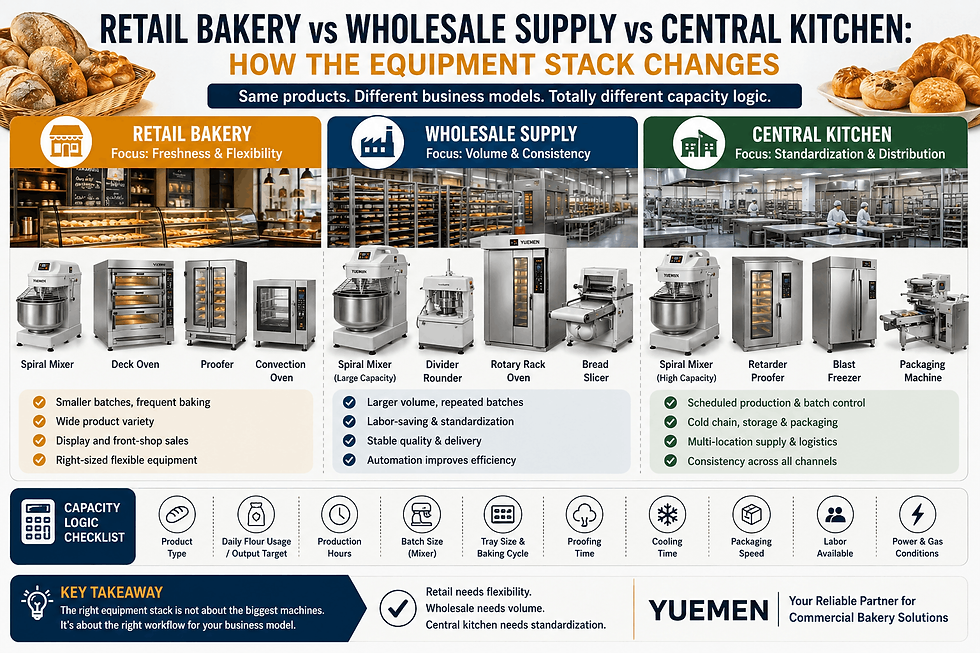
This is why slicer selection should follow the business model. A machine that is practical for a small shop may not be enough for wholesale packing. A high-output slicer may be unnecessary for a retail bakery with limited space and mixed products.
Mistakes That Create Slicing Problems
The most common mistake is choosing the slicer by blade count alone. Blade count matters, but it does not replace loaf size, slice thickness, cooling condition, and packing format.
Another mistake is ignoring loaf dimensions. If the loaf is too tall, too wide, too soft, or unstable, slicing quality will suffer even with a good machine.
Some bakeries also slice too early. This is a major cause of tearing, compression, and poor slice shape.
Another issue is choosing slice thickness without thinking about the market. A thick slice may look premium but reduce slice count. A thin slice may improve portion control but tear easily if the crumb is soft.
Maintenance is often ignored until the machine performs badly. By that point, the bakery may already have lost bread, labor time, and customer confidence.
The final mistake is expecting the slicer to fix weak bread structure. If the loaf is poorly moulded, underproofed, overproofed, underbaked, or cooled incorrectly, the slicer cannot fully correct the problem.
For sliced toast and sandwich bread, slicing quality is connected to the whole process: mixing, moulding, proofing, baking, cooling, slicing, and packing.
How Yuemen Helps Buyers Choose the Right Slicer and Moulder Setup
Yuemen helps buyers choose bread slicing and moulding equipment based on the actual product, not just the machine name.
For toast bread, sandwich bread, and sliced bread production, we usually need to understand the loaf size, loaf weight, slice thickness, daily slicing volume, cooling time, packing method, voltage, available space, and labor plan before recommending a setup.
For many standard toast and sandwich bread applications, the YMQ-31 bread slicer with 12 mm slice thickness is a practical option. It is suitable for bakeries that need regular sliced bread for daily sales, sandwich use, or packaged toast bread.
But the slicer should still be matched with the rest of the line. If the loaf shape is unstable before slicing, the bakery may need to review moulding. If loaf height changes too much, the issue may involve dough weight, pan choice, proofing, or baking. If the bread creates too many crumbs, the problem may come from cooling time, blade condition, or crumb structure.
For buyers planning a full sliced bread process, Yuemen can help review related equipment such as dough mixers, moulders, proofers, ovens, cooling racks, slicers, and packing support. Buyers can also review commercial bakery equipment, a volumetric dough divider, a commercial bread proofer, or a trolley proofer, depending on the production scale.
The goal is not only to cut the bread. The goal is to make the finished sliced loaf look clean, pack smoothly, and create fewer complaints after delivery.
What to Prepare Before Asking for a Bread Slicer Quotation
Before requesting a quotation, prepare the basic production details. These details make the recommendation much more accurate:
bread type
loaf size
loaf weight
crust type
crumb softness
cooling time before slicing
target slice thickness
expected slices per loaf
daily slicing volume
retail, wholesale, or central kitchen use
packing method
available space
voltage and phase
cleaning requirements
whether the moulder, proofer, and oven are already selected
Without these details, a quotation may look complete but still miss the real production requirement.
Conclusion
A bread slicer should not be selected by blade count or price alone.
The right machine depends on loaf type, slice thickness, blade spacing, cooling condition, workflow, maintenance, and packing needs. Poor slicing can create crumbs, waste, bad presentation, customer complaints, and returns.
Clean slicing protects the work already done before the loaf reaches the slicer.
If you are planning sliced bread, toast bread, or sandwich bread production, start with loaf size, target slice thickness, daily output, cooling time, and packing method. Once these details are clear, Yuemen can help recommend a practical slicer and production setup for your bakery.