520mm vs 650mm Dough Sheeter: How to Choose by Output and Sheet Width
Choosing between a 520mm and 650mm dough sheeter is mainly a geometry and workflow decision—not a simple kg/day decision.
Start with the widest dough sheet you actually need, the cutting layout across that sheet, and the tray or product format. Then check whether the wider machine removes real production cycles or only adds footprint and cost.
Short answer: choose 520mm when your required sheet fits comfortably and the cutting pattern already gives the lanes you need. Choose 650mm when 520mm cannot fit the sheet, or when the extra width creates a useful additional cutting layout that reduces handling at your real production volume.
Run the 520mm vs 650mm width check
Use the planner below to separate physical width fit from workload. The output is a buying brief, not a manufacturer capacity guarantee.
520mm vs 650mm dough sheeter: the decision in 30 seconds

Situation | 520mm | 650mm |
|---|---|---|
Required sheet width fits 520mm with your working allowance | Usually the first choice | Optional; justify with cutting yield or future layout |
Required sheet does not fit 520mm but fits 650mm | Not suitable for that sheet orientation | Practical width class |
Wider sheet adds one or more usable cutting lanes | Can still work with more cycles | May reduce cutting/sheeting cycles |
Space is tight and products are mixed | Often easier to justify | Needs a clear width or workflow benefit |
Required sheet also exceeds the 650mm usable width | Too narrow | Too narrow; consider a wider format |
The width number is only a starting point. Ask the supplier for the exact model’s usable sheet width, belt dimensions and operating limits before treating 520mm or 650mm as a guaranteed finished-sheet width.
Start with usable sheet width, not daily dough kilograms

The current version of this article used daily dough-volume bands to choose the width. That is too blunt. Two bakeries can both process 120kg/day and need completely different sheeters: one may make round pizza bases with a few passes, while the other laminates croissant dough through repeated rolling, folding and resting cycles.
For width selection, the first planning equation is simple:
Required nominal width ≈ widest target dough sheet + your planning edge allowance
The allowance is not a universal machine specification. It is a buyer-side planning margin. The exact usable width depends on the machine design and how the dough behaves near the belt and roller edges.
Confirm these width-related specifications on the exact model
Nominal roller or belt width
Supplier-confirmed usable sheet width
Conveyor belt dimensions and working table length
Maximum dough block size or weight recommended for the model
Roller opening / minimum final thickness range
Reversing method, speed control and duty-cycle guidance
How the extra 130mm can change cutting yield
The 650mm format is valuable when the extra width creates a better cutting pattern. The cleanest way to test this is to compare how many repeated product lanes fit across each sheet.
Illustrative example: if you reserve 30mm total as a planning allowance and your cutter needs 110mm across each repeated lane, a 520mm class gives about 490mm of planning width, while a 650mm class gives about 620mm. That means four lanes versus five. The value comes from the additional usable lane—not from the width label by itself.
Input | Why it matters | Buyer question |
|---|---|---|
Target sheet width | Determines whether the product physically fits | Can the exact model produce this width with stable edges? |
Cut pitch across sheet | Shows whether extra width adds useful lanes | How many croissants, strips or slabs fit across? |
Sheet length / belt length | Affects handling of long laminated sheets | Can operators support the full sheet without folding or drag? |
Tray or cutter format | Links sheeting to the next station | Does the sheet match the tray/cutter orientation? |
Passes per dough block | Shows workload intensity | How many rolling cycles are needed per block or lamination sequence? |
Choose by product geometry
Croissants, Danish and laminated pastry
For laminated products, width affects both lamination handling and the number of cutting lanes. A 520mm model can be fully adequate for many retail pastry operations. A 650mm model becomes more attractive when the wider band produces another useful row of triangles or strips, or when your final laminated sheet simply does not fit a 520mm working envelope.
Pizza and flatbread
For round pizza, compare the largest dough diameter plus handling margin with the usable width. For tray pizza or rectangular flatbread, tray orientation matters even more. A 600mm-wide target sheet may naturally push the project toward a 650mm class, but the supplier still needs to confirm actual usable width.
Puff pastry, cookie and cracker slabs
Large rectangular slabs benefit when the wider band matches the cutter, tray or downstream laminating format. If the extra width does not increase the number of usable pieces per sheet, the 650mm machine may only add footprint.
Output depends on production cycles, not width alone
A sheeter’s real contribution to output depends on how many rolling cycles the bakery must complete during the available shift. Width can reduce those cycles when it lets you process a wider band or cut more pieces from one sheet, but it does not automatically increase kg/hour.
A practical workload check is:
Rolling passes per day = dough blocks or sheeted batches per day × average passes per block
Then divide the daily passes by effective sheeting hours to understand how intensively the station is used. This is a workload indicator only. Machine speed, dough condition, resting time, folding, operator handling and cleaning still determine the real cycle time.
When a 520mm dough sheeter is enough
Your widest required dough sheet fits inside the model’s confirmed usable width
Your cutter already achieves the required number of lanes across the sheet
You produce mixed bakery products and flexibility matters more than wide-format repetition
Floor space is limited
The sheeter is an important station but not the dominant production bottleneck
A tabletop or compact standing format fits the operator workflow better
For very small or intermittent workflows, compare the decision with the manual dough sheeter guide for small bakeries before assuming a larger floor-standing machine is necessary.
When a 650mm dough sheeter earns its footprint
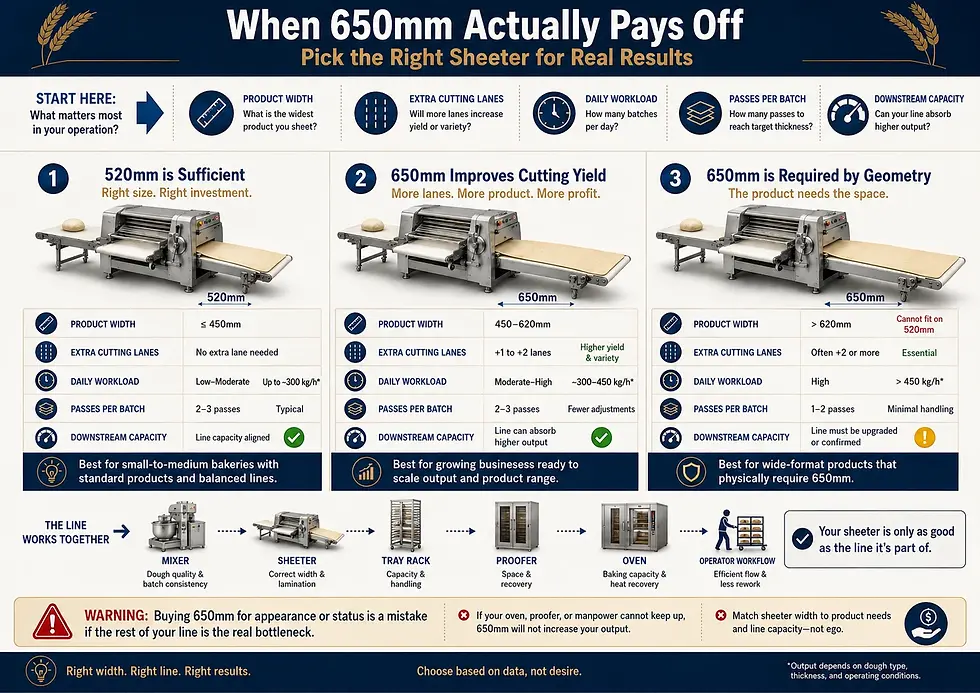
The required sheet does not fit the confirmed usable width of a 520mm model
The extra width creates a real additional cutting lane or a better tray/cutter layout
You repeatedly laminate wide pastry bands
You produce tray pizza, wide rectangular sheets or frozen dough formats that use the width
Operators currently split or reorient sheets because the narrower band is inefficient
The rest of the production line can absorb the additional sheeting and cutting output
If your project already needs the wider format, compare the required geometry with the 650mm floor-standing dough sheeter rather than choosing the machine from width alone.
520mm tabletop vs 520mm floor vs 650mm floor
Format | Best fit | Main trade-off |
|---|---|---|
520mm tabletop | Small bakeries, cafés, pizza prep, occasional or moderate sheeting | Compact footprint, but check belt length and operator ergonomics for repeated lamination |
520mm floor-standing | Daily sheeting where 520mm width is already sufficient | Better working height and workflow without paying for unused width |
650mm floor-standing | Wide-format or lane-sensitive production | More floor space and investment; value depends on using the extra width |
Check the bottleneck after the sheeter

A wider dough band is useful only if the next operations can absorb it. Before paying for 650mm, map the full pastry flow:
Mix and rest enough dough for the planned sheeting rhythm.
Sheet and laminate without waiting for dough blocks or operators.
Cut or form the wider sheet using a compatible table or cutter.
Load trays or freezing boards without creating another manual bottleneck.
Proof, freeze or bake the increased piece flow.
Cool and pack the resulting output without queue buildup.
If you are sizing the full bakery rather than one machine, use the commercial bakery equipment category to check the surrounding mixer, proofer, oven and handling requirements.
What to test before you approve a dough sheeter
Run the real dough formula, not only a dry demonstration dough
Start from the normal dough block size and temperature
Record the number of passes and roller-gap sequence
Measure the final sheet width and thickness at several points
Confirm whether the edges remain usable for your cutter or tray
Test reversing controls and operator reach
Check belt tracking, flour management and cleaning access
Repeat the test after several batches to see whether the workflow remains practical
For operation after installation, the dough sheeter operation and maintenance guide covers calibration, cleaning and routine handling.
Information to send in a sheeter RFQ
A useful RFQ should let the supplier reproduce your width decision. Send:
Main products and dough formulas
Widest required dough sheet in millimeters
Tray size and orientation
Cut pitch or cutter layout across the sheet
Typical dough block weight and dimensions
Average rolling passes and folds per product
Dough blocks or sheeted batches per day
Effective sheeting hours per shift
Expected growth or second-shift plan
Available floor space and preferred tabletop/floor-standing format
Voltage, frequency and phase
Required accessories, guards, flour trays and spare belts
Bottom line
Choose 520mm when the product fits, the cutter already gets the lanes you need, and the wider machine would not remove a real bottleneck. Choose 650mm when the wider sheet is physically required or when the additional width produces a measurable cutting-layout advantage that your downstream line can use.
Do not let a supplier choose the width from daily kilograms alone. Send the actual sheet width, cutter layout, dough block, pass sequence and tray format; then test the exact configuration before ordering.


