Our Baking Products
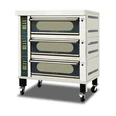
Gas Bread Deck Oven for Bakeries 2 Decks 4 Trays
Model:
G-2D4T

POWER
0.2KW
220V
VOLTAGE

210 KG
N.Weight

900–1200 Items/Day
Capacity

Gas(LNG/LPG)
Energy

Power source
Gas(LNG/LPG)
Shipping Port
Weight
Material
Stainless Steel
1340*900*1355 MM
Functions
Size
Capacity
Certifications
CE/SABS/GSO/ISO
Made in China
Place of Production
Price
Guangzhou China
210 KG
2 Trays/Deck
900–1200 Items/Day
$600-$18,000
Specification
2 deck 4 tray gas deck oven for bakeries that need two active chambers and a gas-ready production upgrade without jumping straight to 3 decks
The YMC-40RI is the middle-format gas deck oven for bakeries that have moved beyond one-chamber baking but are still deciding whether a full 3 deck project is justified. With a 1340 × 900 × 1355 mm body, gas heating, light 220V control power, and a stated 900–1200 items/day range, it suits retail bakeries, mixed bread-and-snack shops, bakery cafés, and foodservice kitchens that want two dependable baking zones in a manageable footprint.
Its real commercial value is the combination of chamber separation and gas-fired bake logic. One deck can stay on bread, buns, or flatbread while the second handles pastry, pizza-support work, refill batches, or another product family that should not compete for the same timing window. That separation is usually more important than headline tray count. For many buyers, this is the point where a deck oven starts functioning like a genuine daily production machine rather than a compact backup station.
Compared with the 1 deck 2 tray gas model, the YMC-40RI is the right move when the business now needs parallel scheduling, not just more room in one chamber. Compared with the 3 deck 6 tray gas model, it stays more disciplined in footprint, staffing rhythm, and project size, which matters for bakeries that are growing but not yet running three live baking streams all day. Compared with the electric 2 deck 4 tray model, the difference is not production role so much as utility planning: this gas version makes the most sense where approved gas supply is already practical and reducing electric heating dependence is operationally useful.
Where this 2 deck gas format fits best
Growing bread-led and mixed bakery production.
It is a good fit when one chamber no longer covers the menu, but the bakery still wants a controlled project scale.Gas-ready sites that want real deck separation.
When gas infrastructure is already in place, this model offers a practical step into two active chambers without a heavy electric heating load.Main oven for smaller operations, support oven for larger ones.
For some bakeries it can be the primary daily deck oven; for larger facilities it often becomes a focused station for one product lane.
Where the boundary starts
This is not the best long-term choice if both decks are already likely to stay full for most of the shift. In that case, the 3 deck 6 tray gas model usually becomes the more realistic next step. It is also not the simplest option when gas approval, flue planning, or local compliance still look uncertain, because the electric 2 deck 4 tray version may be easier to implement. And when the real target is larger repeated bread batches with trolley workflow, rotary deserves serious comparison before the bakery keeps stepping deeper into deck capacity.
Description
More Information
How a 2 deck 4 tray gas oven changes bakery workflow
In practice, this oven works best in a line that already includes dough prep, proofing, baking, and cooling as separate steps. A typical layout may include a spiral mixer, shaping bench, proofer, the oven, and cooling racks. In that setup, one deck can hold core bread items while the second deck handles buns, pastry, refill work, or one product family with a different bake rhythm. That reduction in chamber conflict is usually the main reason to choose this size.
Nearby model comparison with parameter logic
Choose the 1 deck 2 tray gas model when one chamber still covers the menu.
That step stays around 400–600 items/day with a smaller 1340 × 900 × 700 mm body and makes more sense for focused single-lane baking.Choose this 2 deck 4 tray gas model when two active chambers solve the real daily bottleneck.
At 900–1200 items/day and 1340 × 900 × 1355 mm, it is the practical middle point between entry gas baking and larger multi-deck production.Choose the 3 deck 6 tray gas model when the bakery already needs a third live chamber.
That model moves to a taller 1340 × 1120 × 1775 mm body and a 1300–1600 items/day range, which is justified when two decks no longer leave enough scheduling room.
Cross-category comparison: gas deck vs electric deck and rotary
Choose this gas deck oven instead of the electric 2 deck version when gas is already practical on site and the buyer wants deck-style baking without building around a 13.2KW electric heating load. Choose the electric version when gas approval or exhaust planning could slow installation. Choose this deck oven instead of rotary when chamber-by-chamber product control still matters more than trolley-style batch throughput. Choose rotary when the bakery is becoming bread-heavy enough that batch efficiency and repeated rack rhythm matter more than manual chamber scheduling.
Scenario comparison: who should stop here and who should size up
Bakery café or mixed shop: this can be the main oven when two daily baking zones cover the menu comfortably.
Growing retail bakery: it is the right step if the business needs two decks now but has not yet proven the need for a third.
Fast-growing bread shop: if both decks are already forecast to stay busy through peaks, the 3 deck 6 tray gas model is usually the more honest long-term choice.
Useful pairing logic for this model
Spiral mixer: a strong match when bread or bun production is the main daily use.
Proofer or retarder proofer: helpful when one deck depends on stable dough readiness rather than irregular manual timing.
Divider, rounder, or moulder: useful when regular bread shaping needs to feed two active chambers smoothly.
Convection support oven: practical when delicate pastry or snacks should not occupy one of the two gas decks.
FAQ-style buying clarification
Who is this model best for?
Buyers who want two daily gas-fired baking zones in a manageable footprint without committing to a 3 deck layout yet.Who should not buy it?
Operations that already know two decks will stay saturated most of the day should compare the 3 deck 6 tray gas step immediately.When is the electric version better?
When electrical capacity is available and gas compliance or flue planning would create unnecessary project complexity.When is rotary better?
When the bakery is moving into heavier repeated bread throughput where rack-based batch rhythm creates more value than separate deck scheduling.What should be checked before ordering?
Confirm gas type, regulator and exhaust requirements, working clearance, and whether proofing, prep, and cooling can support two active chambers.